
Art Therapy Activities for Anxiety: 15 Techniques
Organized by How Your Anxiety Shows Up
31.1% of US adults will experience an anxiety disorder at some point in their lives — making it the most common mental health condition in the country. Most won’t find a single approach that works every time. That’s not a failure of willpower. Anxiety doesn’t always show up the same way, and what calms a panic attack is different from what untangles chronic worry or stops a rumination loop.
Art therapy offers something most interventions don’t: it works with the body, not just the mind. These 15 activities are organized by how your anxiety actually presents — not by art medium. Find the category that matches today. Start there.
Art therapy offers something most interventions don’t: it works with the body, not just the mind. These 15 activities are organized by how your anxiety actually presents — not by art medium. Find the category that matches today. Start there.
Visual art therapy produces a large effect on anxiety and lowers cortisol in 75% of adults after just 45 minutes of art-making, regardless of skill (Huang et al., Journal of Psychiatric and Mental Health Nursing, 2025; Kaimal et al., Drexel University, 2016).
Why Does Art Therapy Actually Reduce Anxiety?
Creative art-making simultaneously activates three major brain networks — the Default Mode Network, the Salience Network, and the Central Executive Network — a combination that’s rare for most activities and appears central to why art therapy works (PMC / Frontiers in Behavioral Neuroscience, 2024). This triple-network engagement also increases heart rate variability (HRV), a physiological marker of parasympathetic tone — the opposite of anxious arousal.
The practical result: making art interrupts the anxiety loop at the neurological level. You don’t think your way out of anxiety during art therapy. Your nervous system shifts first, and the thoughts follow.
None of this depends on skill. The cortisol reduction works whether you’re an experienced artist or have never held a paintbrush. The mechanism is attentional engagement with sensory, hands-on activity — not aesthetic output.
The practical result: making art interrupts the anxiety loop at the neurological level. You don’t think your way out of anxiety during art therapy. Your nervous system shifts first, and the thoughts follow.
None of this depends on skill. The cortisol reduction works whether you’re an experienced artist or have never held a paintbrush. The mechanism is attentional engagement with sensory, hands-on activity — not aesthetic output.

Art Therapy Activities for Acute Anxiety and Panic
Acute anxiety has a physical quality — racing heart, chest tightness, shallow breathing. The activities here work with that physical state directly. They don’t ask you to process anything. They require only your hands and a few minutes.
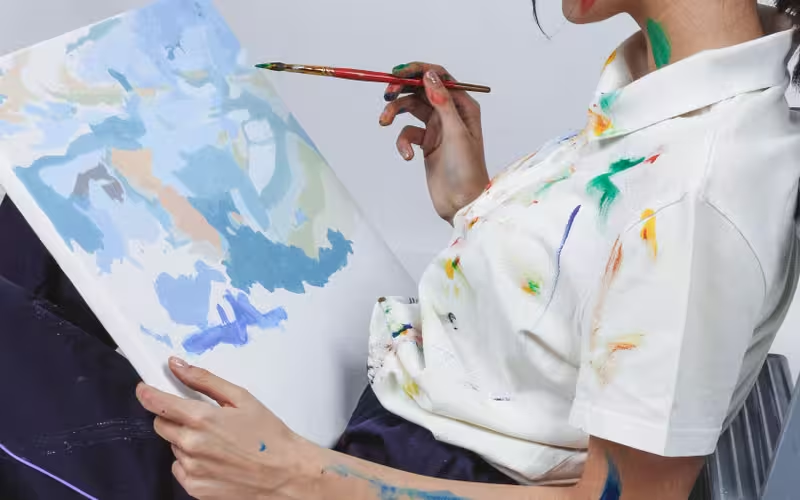
1. Breath Mapping
- Materials: Watercolor paint, paper, medium brush
- How to do it: Load your brush. Inhale slowly. On each exhale, lay one long, deliberate stroke across the page. Don’t plan a composition. Each stroke is one breath. When your breathing slows, look at what you made — it’s a visual record of your nervous system calming down.
- Why it works: Externalizing breath onto paper gives your mind something to track other than fear. The rhythm of the activity regulates the breath directly.
- Materials: A large sheet of paper, markers or crayons
- How to do it: Draw a simple body outline. Mark where your anxiety lives right now — tight chest, clenched jaw, heavy shoulders. Use color, symbols, or words. Then mark where you feel neutral or calm.
- Why it works: Naming somatic experiences reduces their intensity by engaging the prefrontal cortex. Anxiety stays overwhelming when it stays abstract; drawing it gives it a location and a boundary.
- Materials: Any paper — newspaper, junk mail, old magazines
- How to do it: Tear paper by hand for 3-5 minutes. No composing, no gluing — just tearing. Optionally, arrange the pieces into something new afterward.
- Why it works: Physical force against material discharges the muscular tension that acute anxiety creates. The reconstruction phase restores a sense of control.
- Materials: Water-based paint or food dye frozen into ice cubes. Paper.
- How to do it: Hold a colored ice cube and draw directly on paper. It melts as you work. The image continues to develop as it dries.
- Why it works: Cold temperature is a physiological interrupt for the panic response. The sensory novelty pulls attention out of threat-mode without requiring any cognitive effort.
- Materials: Large paper (butcher paper works), thick brush or sponge, any paint
- How to do it: Tape paper to the floor or wall. Use your whole arm — slow, wide sweeping strokes. Let the movement come from the shoulder, not the wrist.
- Why it works: Anxiety and panic contract the body. Large, expansive physical movement during creative work directly counters that contraction and activates the release of muscular tension.
- Of these five, tearing paper sounds almost too simple. It isn’t. There’s something specific about the sound and resistance of tearing that reaches the physical part of anxiety — the part that tight breathing and racing thoughts can’t touch on their own.
Art Therapy Activities for Chronic, Background Anxiety
Chronic anxiety doesn’t arrive dramatically. It’s the low hum — the second-guessing, the hypervigilance, the exhaustion of always being slightly on alert. These activities are designed for sustained, regular practice rather than crisis moments.
The 10 Art Therapy Activities for Depression:
6. Mandala Coloring (Daily Practice)
- Materials: Pre-printed mandala designs (free printables available online), colored pencils or fine-tip markers
- How to do it: Color one mandala per day at the same time — after waking, before bed, or during lunch. Work from the center outward. Choose colors by instinct. Complete each section before moving to the next.
- Why it works: Mandala coloring reduced STAI-S anxiety scores from 42.90 to 29.71 (p < 0.001) in a 2024 RCT — while controls showed no change (PMC11288254, 2024). The structured, repetitive format drives the effect specifically; free-form coloring doesn’t produce the same results.
- Materials: Small sketchbook, pencil or pen
- How to do it: Each day, spend 10 minutes drawing one ordinary object — a coffee cup, a leaf, a shoe. Draw only what you see, not what you remember. Look more than you draw.
- Why it works: Sustained, non-evaluative attention to the present moment is the core mechanism of mindfulness practice. Slow observational drawing forces that state without requiring meditation technique.
- Materials: A blank journal, any drawing or writing tools
- How to do it: Each evening, fill one page with anything — a drawing of what happened today, an abstract mark, a color that captures how the day felt. No rules. Don’t review it for 30 days.
- Why it works: Externalizing daily experience reduces its emotional load. Mindfulness-based art therapy (MBAT) produces a medium effect size on anxiety across 14 studies (PubMed, 2020). Consistent daily practice is the key variable.
- Materials: Fine-tip black pen, white index cards or small paper
- How to do it: Fill one index card per day with a single repeating pattern. Different pattern each day. Start at any corner and fill the space — no planning required after you choose the pattern.
- Why it works: Repetitive pattern creation is a structured attention anchor. Chronic anxiety is partly a failure of attentional regulation. Zentangle provides regulation through structure rather than effort or willpower.
- Materials: A monthly calendar grid, small colored dots or markers
- How to do it: At the end of each day, assign a color to your anxiety level — define your own color scale. Dot or fill each calendar square. At month’s end, look at the pattern.
- Why it works: Chronic anxiety tends to flatten into the feeling that it never changes. Tracking shows variation — which is evidence it does. Seeing the data disrupts the cognitive distortion that things are always bad.
Art Therapy Activities for Anxious Overthinking and Rumination
Rumination — the cycling, repetitive thought loops — responds differently from panic or chronic tension. These activities work by giving the mind a more engaging object for its attention, and by externalizing the thoughts that keep cycling.
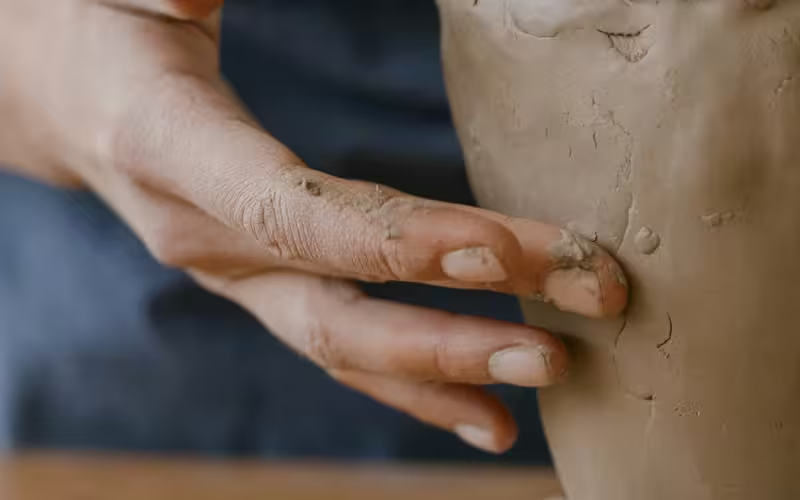
Clay-based art therapy produces rapid and measurable anxiety reduction. A 2024 study of 53 university students found that one semester of ceramic art coursework reduced the proportion with severe anxiety from 9.4% to 0%, while the percentage reporting no anxiety increased from 39.6% to 64.2% (PMC / Frontiers in Psychiatry, 2024).
11. Clay Work
- Materials: Air-dry clay or modeling clay ($3-5 at most craft stores)
- How to do it: Start by kneading and squeezing the clay without any intention. After 5 minutes, shape it into whatever the clay seems to want to become. Don’t force an outcome.
- Why it works: A ceramic art intervention reduced severe anxiety cases from 9.4% to 0% in university students (n=53) after one semester (PMC / Frontiers in Psychiatry, 2024). Tactile engagement demands the kind of present-moment attention that leaves no bandwidth for ruminative thought loops.
- Materials: One magazine, scissors, glue, paper
- How to do it: Give yourself a specific constraint: “Cut only images that feel like relief.” Or: “Find three images that represent what I’m actually worried about.” Limit yourself to 15 minutes. Glue what you find.
- Why it works: Constrained search tasks interrupt rumination by providing a structured, achievable goal. The physical act of cutting and arranging externalizes abstract worry into something visible on paper.
- Materials: Paper, pencil, colored pencils
- How to do it: Draw your current worry as a character or scene. Give it a face, a setting, a size. What does it actually look like when you put it on paper?
- Why it works: Rumination thrives in abstraction. Making the worry visible and specific changes your relationship to it. It becomes a thing you’re looking at rather than a loop you’re caught inside.
- Materials: Pen, paper
- How to do it: Set a timer for 5 minutes. Let your hand move across the page with no intention. Don’t plan, don’t evaluate, don’t lift the pen. Just move.
- Why it works: Automatic drawing engages motor activity and creative flow simultaneously — both incompatible with the rumination loop’s demand for evaluative, verbal processing. You can’t ruminate and move at the same time.
- Materials: Watercolors or acrylics, paper
- How to do it: Paint an abstract map of your current mental state. What’s at the center? What’s at the edges? Where does it feel crowded, where does it feel open? No realism required.
- Why it works: Creating a spatial representation of an emotional state activates the observing mind — the part that watches experience rather than being consumed by it. Anxiety collapses that distance. This activity restores it.

How to Choose the Right Activity Right Now
The 15 activities fall into three situations. Identify yours before picking:
Acute anxiety or panic in the moment → Start with breath mapping (1), tearing paper (3), or large-muscle painting (5). These need almost no materials and work within minutes. You don’t need to set up anything or think first.
Chronic low-level anxiety as a daily practice → Mandala coloring (6), daily observation sketch (7), and visual journal (8) are all designed for daily 10-15 minute use. Pick one and practice it at the same time each day for two weeks before evaluating whether it’s working.
Stuck in a thought loop → Go directly to clay work (11) or the worry illustration (13). Both require you to locate and externalize the anxiety — which interrupts the loop’s mechanism at the source.
Acute anxiety or panic in the moment → Start with breath mapping (1), tearing paper (3), or large-muscle painting (5). These need almost no materials and work within minutes. You don’t need to set up anything or think first.
Chronic low-level anxiety as a daily practice → Mandala coloring (6), daily observation sketch (7), and visual journal (8) are all designed for daily 10-15 minute use. Pick one and practice it at the same time each day for two weeks before evaluating whether it’s working.
Stuck in a thought loop → Go directly to clay work (11) or the worry illustration (13). Both require you to locate and externalize the anxiety — which interrupts the loop’s mechanism at the source.
When Do You Need a Therapist Instead of Self-Directed Practice?
Self-directed art therapy is appropriate for most everyday anxiety. For some situations, professional support matters more.
Consider working with a registered art therapist if your anxiety: prevents normal daily functioning, involves trauma or PTSD, co-occurs with severe depression, hasn’t responded to self-directed practice after 4-6 weeks, or involves thoughts of self-harm.
A trained therapist can guide processing in ways self-directed practice can’t — particularly around trauma, where verbal exposure in standard therapy can retraumatize, and where the therapeutic relationship itself is part of the treatment.
Consider working with a registered art therapist if your anxiety: prevents normal daily functioning, involves trauma or PTSD, co-occurs with severe depression, hasn’t responded to self-directed practice after 4-6 weeks, or involves thoughts of self-harm.
A trained therapist can guide processing in ways self-directed practice can’t — particularly around trauma, where verbal exposure in standard therapy can retraumatize, and where the therapeutic relationship itself is part of the treatment.
Frequently Asked Questions
Cortisol levels — a physiological marker of stress — drop within 45 minutes of art-making in 75% of adults, even in a first session, regardless of skill level (Kaimal et al., Drexel University, 2016). For structural anxiety reduction over time, most clinical studies measure effects after 6-8 weekly sessions.
Most activities here need only paper and a pen. Mandala coloring requires a printed template and colored pencils — under $5 total. Clay ($3-5 at most craft stores) expands your options significantly for the tactile activities. Nothing expensive is required.
They address different mechanisms and work well together. CBT targets cognitive distortions through verbal processing. Art therapy reduces physiological arousal and externalizes emotion through non-verbal expression. A 2024 meta-analysis in JAMA Network Open found art therapy produces clinically meaningful anxiety improvements whether or not it’s combined with other treatments (Joschko et al., 2024).
Yes, for everyday anxiety and stress. These 15 activities are safe for self-directed home use. For clinical anxiety disorders or trauma, periodic sessions with a registered art therapist add guided processing that self-directed practice alone doesn’t provide. The two work well in combination.
Start With One Activity Today
Anxiety doesn’t need a perfect treatment plan. It needs one thing to do when it shows up. Pick the category that matches your anxiety right now — acute, chronic, or ruminative — and try one activity for 15 minutes. The research is clear that even a single session changes your cortisol levels. The practice builds from there.